- The Full Contents
- Search the Seger File
- The 2011 Tour Page
-
- FACE THE PROMISE
- 2010 Updates
- 2009 Updates
- 2008 Updates
- 2007 Updates (Jan -July)
- 2006 Updates (Jan-Sept)
- 2006 Updates (Oct-Dec.)
- 2005 Updates
- 2004 Updates
- 2003 Updates (July-Dec)
- 2003 Updates (Jan-June)
- 2002 Updates
- 2001 Updates
- 1998-2000 Updates
- Nine Years Online
- The Seger File's Birthday Party
- Unreleased Tracks
- Vault V
- 10 more unreleased tracks
- Vault 4
- 16 more unreleased tracks
- Forward Into the Vault --
- 26 more unreleased tracks
- Return to the Vault -- 18 More Unreleased Tracks
- The Vault --31 Unreleased Tracks
- Recorded but Unreleased --Unreleased Seger from A-Z
- Photos
- Photos
1
 Photos
2
Photos
2 - Photos
3Photos
4
- Hall of Fame Photos
- Settle Annex
- A collection of great Seger photos
- Misc.
- Dylan's "Denver"
- The Albums
- Ramblin' Gamblin' Man
- Noah
- Mongrel
- Brand New Morning
- Smokin' O.P.'s
- Back in '72
- Seven
- Beautiful Loser
- Live Bullet
- Night Moves
- Stranger in Town
- Against the Wind
- Nine Tonight
- The Distance
- Like A Rock
- The Fire Inside
- Bob Seger's Greatest Hits
- It's A Mystery
- Greatest Hits 2
- Face the Promise
- Other Albums
- The Promised Live Album
- The Promised Studio Album
- Seger on the Edge
- The Bob Seger Collection --(Australian Greatest Hits)
- Seger Classics
- A Very Special Christmas,1987
- Other Album Appearances
- The Seger Tribute Album
- Sing Your Own Seger
- Perfect Albums?
- Selected Singles
- Check the Label
- Who Picks the Singles?
- Early Singles
- The Lonely One
- TGIF/First Girl
- Ballad of the Yellow Beret
- East Side Story
- Persecution Smith
- Sock It To Me, Santa
- Vagrant Winter/Very Few
- Heavy Music
- 2+2=?/Death Row
- Ramblin' Gamblin' Man
- Looking Back
- If I Were A Carpenter
- Bombs Away
- Understanding
- Chances Are
- My Take on Chances Are
- Reaching Number One
- Other Seger Tracks
- Released on Singles, But Not on Albums
- Covered by Others
- Written By Seger, Recorded by Others
- Videos
- Night Moves (SNL)
- Making Thunderbirds
- Old Time Rock and Roll
- American Storm
- Like a Rock
- Shakedown
- Real Love
- Fire Inside
- Night Moves (New)
- Turn the Page
- It's A Mystery
- Chances Are
- Ten for Two
- The Cobo Hall Tapes
- The Palace Tapes
- Influences/Other Bands
- Soundtracks
- TV Appearances
- Like a Truck
- Who Does the Song Belong To?
- Ancient History Dept.
- How Seger Sees Rock/Truck
- Singer or Salesman?
- Gatsby, Seger and Victory
- The Mystery Man
- How the Song Became An Ad
- Good Song, Great Ad?
- Bad Press, Bad Precedent
- Through the Lean Years
- Bob's View
- Insults and Dead Horses
- Fix Or Repair Daily
- The Early Years
- Early Days
- Motor City's Burning
- Places He Played
- Jackson
- More Dues-Paying Years
- Career, Misc.
- Lead Singer Vs. Guitar Player
- The Slow Road to Success
- The Requisites of Greatness
- Theories: Why It Took So Long
- "You Are Now Leaving Seger Territory"
- Punch
- Breaking Out
- What Is Success?
- Bands
- Early Bands
- The Decibels
- The Town Criers
- The Omens
- Democracy Rocks
- Later Bands
- Bob Seger and the Last Heard
- The Bob Seger System
- STK
- Julia/My Band/Borneo Band
- Muscle Shoals band
- The Silver Bullet Band
- Back-up Systems
- Shaun Murphy
- Karen Newman
- Related Bands
- Detroit All-Stars
- Alto Reed
- Blue Highway (Drew Abbott)
- Bio, Part 1
- Detroit? Ann Arbor?
- We Even Sang the Parts the Instruments Were Playing
- A Father Leaves
- Fire and the Memory of Love
- All the Wild, Wild Good Times
- Personality
- Interests and Hobbies
- Predicting the Future, Then and Now
- Bio, Part 2
- On Growing Older
- Politics
- The Seger Work Ethic
- You Can't Miss That Driving Rain
- Friends and Family
- Let's Dig Up Something Really Nasty
- Katmandu
- I'm Gonna Tell My Tale, C'mon
- Of Caves and Barbed Wire
- Misc.
- Songwriting
- Early Tours and Shows
- The Oakland Mall
- Jackson
- The Primo, R&R Farm, Suds Factory and Chances Are
- The Agora
- On the Road
- Jackson County Fair
- Pontiac, the Michigan Jam and Other Victories
- Seger in the Arena
- The 1983 Tour
- The 1986-87 Tour
- The Last Tour?
- They'll Never Be in The Arena, But They Get to Write the Reviews
- Savannah
- Charlotte
- Philadelphia
- Oakland
- Miami
- San Francisco
- Seattle
- Houston
- New York
- Los Angeles
- Vancouver (Canada)
- Greensboro
- The 1996 Tour
- The Set List Discussed
- The Set List Presented
- The Set List Analyzed
- Bringing the Family
- Tour Notes
- Thirsty for Seger
- A Review of the Reviews
- Charleston
- Nashville
- Palace of Auburn Hills
- Washington
- L.A.
- The 2006-07 Tour Pages
- Readin' O.P.'s
- A compilation of e-mail messages. Some favorite are:
- -- Hope to see you tonight
- -- Motor City Rock
- -- The FargoDome
- -- The 7-Eleven and the Winter Olympics
- -- He gave me a strange look
- -- Now that we're older
- Brand New Email
- More great letters.
- -- Seger, Sinatra, Cobain
- -- My Dad, Bob and Charlie Martin
- -- I work for General Motors
- -- Seger and Mohammad Ali
- -- The last thing I hear from Bob Seger
- -- Road trip to Ann Arbor
- -- I never spoke to Bob, but he always spoke to me
- Brand New Email Pt. II
- -- Bob at the Roseland Inn
- -- Seger interview
- -- Backstage with a bad pass
- -- Put the car in park
- -- Starry August nights
- -- Cool me down
- -- The bridge from Motown
- -- The Seger-starved masses plead for tour news
- -- The Kiss File?
- Seger Stories and Misc. Email
- --The best thing you could say
- --Blue and Julia
- --Rockin' with Fidel
- --Early days of baseball and Bob
- --Follow your heart
- --Waving with the lighter
- Email '05
- --About Drew Abbott
- --On 2+2
- --On "The Lonely One"
- --About Tom Neme
- --About Charlie Martin
- --Shows
- --The Toledo Jam
- --About Pep Perrine
- --About Jim Bruzzese
- --Early days
- --Fans
- --Early songs
- Falsehoods
- Seger
Inks SimTour Deal, Gets
Ready
to Rock
- Capitol Releases "Dee-Pah!
- The Seger Cam is back online
- The Michigan Jam 2
- The
Seger versus.
SpringsteenComplexo-Meter
- The Medicated Top 20
- Misc.
- Reese: Money for Music
- Get Back to Work
- A guide to surfing The Seger File at work.
- The Primo Photo
- The Rolling Stone Letter
- The Imaginary Interview
The Seger
File
An unofficial web site about the music of Bob Seger
This section of the Seger File Last updated July 2006
      For the latest updates, see News & Updates page.
          Edited by Scott Sparling
sparling@spiritone.com
Back in '72
- January 1973
- Bob Seger, with "My Band," friends (including J.J. Cale), and the Muscle Shoals Band.
Data
Reached 188 on the Billboard album chart.
Every legendary artist has a legendary album that's hard or impossible to find, and this is Seger's. Never released on CD, it's available only in used stores on vinyl (or possibly cassette). The album has even been bootlegged, under the title "15 Years Ago." (The bootleg appeared in 1987; hence 15 years ago would have been 'Back in '72.')
Even Punch claims not to have a copy of "Back in '72," according to Detroit Free Press columnist Bob Talbert, who writes: "When Detroit rock legend Bob Seger and his manager-from-the-beginning Punch Andrews wish to hear an original cut off an early vinyl album like "Back in '72' or "Smokin' O.P.'s" Andrew says, "We have to call 'RIF or WLLZ and get them to play it for us. We gave all the original albums away. We sent 'em all out for charity auctions. We took a look 10 years ago and found we didn't have an original vinyl album left." Bob Talbert, August 2, 1992, Detroit Free Press, "Some famous folks have lost the things that created fame."
My guess is it's a bluff. People probably call Punch all the time wanting to buy those albums -- this Talbert piece sounds like a bit of disinformation designed to get people to stop calling. It's hard to believe they're so disorganized as to give away every last copy of a classic album.
Back in '72 album owes most of its ongoing fame to "Turn the Page," one of the two or three most popular Seger songs. But more than that, the whole album captures the energy of a young Seger just on the cusp of greatness. Seger has said he won't reissue the album in CD format because he feels many of the vocals are bad.
Seger: "Back In '72 has a couple of decent songs on it, but the mix is so awful. One of these days I'm going to get some time, and I'd like to sing some of those songs again. I thought I sang some of those so terrible." Joanne Zangrilli, Goldmine, November 1990
To my mind, the raw energy and rough feel of the vocals are priceless.
Standout cuts
 Turn
the Page
Turn
the Page
One of Seger's most enduring songs,"Turn the Page" remains in the live show to this day.
Seger: "We recorded "Turn the Page" four times over a period of three years, until we finally got the cut...my manager hated that song...[he said] 'it's too down, it's too dark'...[but] that is my favorite song on the album." Early 1975 radio interview.
"You do have a lot of dark days on the road...you have a lot of good days, too...but basically we're in a very dog-eat-dog business, and you can get pretty dark sometimes, and if you're able to translate that, which I think Turn the Page" does more effectively than anything else I've ever done before..." Early 1975 radio interview.
"It's amazing, that song,
which was never a 45 or anywhere near it because it's a five
minute song and it is very laid back, very low key...but
we've played markets where we've never been, and we've
played that song, and it's like, you know, [laughs]
Barbra Streisand doing "People" or something...people start
applauding, a little bit of applause off in the corner..."
Early 1975 radio
interview.
The lyric is dated, Seger acknowledges. "But people don't seem to care and fans get angry if you don't do it." Richard Harrington, August 17, 1986, Washington Post. "Bob Seger: Rocking On, With the Voice of Experience."
In at least two (unscientific) polls that I'm aware of, "Turn the Page" has been named as Seger's most popular song. (It came out on top in a Detroit Free Press call-in poll in 1994, and in an elaborate NCAA-style tournament on AOL in 1998. During the tourney, 128 Seger songs were randomly paired up with each other. People visiting the board voted on their favorite in each pairing until there were 64 songs, then 32, then 16, 8, 4, and 2. Finally, only "Turn the Page" remained.)
Of course, most fans who name it as their favorite are remembering the version from Live Bullet. Back in '72 has never been reissued on CD, so the vast majority of Seger fans have probably heard the studio version only rarely, unless they bought the cassette single released around the time of the Greatest Hits album.
That's too bad. The studio vocals, if anything, are more heartfelt, especially in the final, repeated chorus. The instrumentation is different too: it's the keyboard, not the sax, that carries the song in the studio version. The up and down piano chops that lead us into the chorus are suggestive of Leon Russell's "Tightwire" -- the sax is saved for the very end, and even then, it's not that big a deal. Live, of course, the sax is practically the signature element .
In fact, tor the first three years of playing the song, Seger didn't travel with Alto Reed (who was known as Tommy Cartmell at the time), so there was no live sax in the song: "We have a Mellotron that simulates the sax very well, though...I play piano, and the organ player plays a violin-kind-of Mellotron wall, and he covers the sax pretty good." Early 1975 radio interview.
The cassette single contains both the live and the studio version back to back , which makes it worth owning. (It also includes a version of "Night Moves" with the last 30 seconds ludicrously edited away, as if "I remember, I remember, I remember" weren't a key element of the song....)
What makes the song so popular? Why, after 25 years, is it still perceived by many as Seger's best song? After all, a lot of other excellent songs have faded into Seger's discography as obscure album cuts.
The answer, partly, is that "Turn the Page" is much more than just "a road song," as it is often described. True, on the surface, the lyrics describe the quest of a regional rock star -- but the emotions they touch run much deeper.
Ultimately, "Turn the Page" is a song about the desire for connection --particularly between a man and a women, though the lyrics deftly take it far beyond sexual connection alone. At the center of the song is the difficulty of truly coming together with another. The lyrics remind us of how far we will go to overcome these difficulties and of the loneliness and yearning we will face along the way.
Only Seger with his Midwest roots could conjure up a highway "east of Omaha" and make it sound like the loneliest corner of the soul. The economy of the lyric is astonishing -- with one powerful phrase he gives us all the empty distance we face in seeking connection. (It's no accident that one of his later albums is titled "The Distance.") I'm tempted again to say that this is the distance a boy abandoned by his father might know in a very potent way -- but I also remind myself that I may be reading too much into that early event in Seger's life.
The second verse -- the one Seger considers dated -- gives us the people we meet on this journey. You feel their eyes and you sometimes hear their unkind comments, but that's as close as you get to any human contact.
The last verse has the song's greatest power. On stage -- even in some small-time bar -- you're "a million miles away"...presumably a million miles from the loneliness of the previous verses. But it's fleeting. Nine albums later, Seger sings "I try to make some moment last...I watch it slipping past." The moments of fulfillment in the spotlight don't last too long either. At the end of the day (to borrow that horrid business cliche) what you're left with is the ringing of the amplifiers. Your need for connection, despite the success on stage, is as strong and as unfulfilled as ever.
That yearning is captured in one of Seger's most brilliant lines: "You smoke the day's last cigarette, remembering what she said." Not what she looked liked, or what she did, but what she said. The line testifies to the enduring power of words and reminds me of a Kesey line in Sometimes A Great Notion, to the effect that a man can beat you senseless in a barroom fight and you recover; but a woman melts half your brain for a lifetime with a sentence or two.
"Remembering what she said..." -- It's a lyric as good as any you'll find by Dylan, Joni Mitchell, Jackson Browne, or any of the songwriters generally considered great lyricists.
One dissenter I know has described "Turn the Page" as self-pitying. But it's not. The genius of the song is the switch from 2nd person to 1st person. ("You think about the woman, or the girl you knew the night before"...but "here I am, on the road again.") The lyrics are so well-crafted, you barely notice the switch, but the switch is essential. If the verses were written in the 1st person, they would sound self-pitying; and if the chorus was written in 2nd person, it wouldn't have nearly the impact. I doubt if many listeners notice it, but the switch from 2nd person to 1st person and back makes all the difference in the world.
The other stroke of genius is in the last line...or rather, the last missing line. In a million years, it wouldn't have occurred to me to leave off the final "Turn the page." But by leaving us hanging with the lingering "There I go..." Seger gives the song a haunting, yearning feeling that is absolute perfection. For all the appreciation it has gotten, I don't think the song is appreciated nearly enough
Of course, the lyrics are only part of the song's success. The live performance, the plaintive sax, the vocals and the simplicity of the song all come together to create its power. It's not my favorite Seger song, but it's one of his classics by any measure. And as the first Seger ballad to achieve mass popularity, it's also an important, maybe even pivotal song in his career.
(Alternatively, I suppose there's a different way to analyze the song. You could view "Turn the Page" as a song about how our careers get in the way of connection -- after all, Seger wouldn't be out there east of Omaha if he weren't aiming for career success in the form of rock and roll stardom. That's valid, but again, that's the surface story. The emotional connection is really underneath. Anyway, I doubt if there's many workaholic, connection-deprived CEO's walking around humming "Turn the Page.")
Seger: "The story, of course, occurred when I was playing with Teegarden & VanWinkle, and Monk Bruce. We had these two hulking motorcycle guys who used to set up the equipment...We were on our way from Madison, Wis., or some place. The big guys were sleeping, and the skinny little rock guys went into this roadside place to get something to eat." Two salesmen gave Teegarden a bad time about his hair. "We had to drag him out. It's a good thing they didn't follow us; little did they know what was waiting for them in the truck. Those guys were big." Gary Graff, October 1994, Detroit Free Press. "Bob Seger Tells The Stories Behind The Hits."
Rosalie
A great rocker, written about CKLW program director Rosalie Trombley. My memory is that it got less airplay on CK than other stations, and I've always wondered if they avoided playing it a little just because of the reference.
It's a killer song and was covered by another great band -- Thin Lizzy. In fact, it was one of the first Seger songs to be recorded by another popular band.
According the The Classic CKLW Page, Rosalie Trombley "was recognized as one of the pre-eminent star makers in radio. When she programmed a record it was almost sure to be a smash. Canadian artists like The Bells "Stay Awhile", Motherlode "When I die", Blood Sweat and Tears (David Clayton Thomas is Canadian) "Spinning Wheel", The Guess Who "These Eyes" and Gordon Lightfoot "If You Could Read My Mind" and many others owe a bunch of royalty checks to Rosalie and CKLW."
Back in '72, Neon Sky, I've Been Working
The title track simmers and boils (and includes the lyric "You know my music died and hurt my pride, but somehow I pulled through, back in '72"). Seger claimed that the song never went over well live, so it never became part of the live act. Too bad -- it's a gem.
Other standout cuts include "Neon Sky," (the vocal delivery on the line "The devil is red, but his money is green" is priceless and captures the essence of early '70s Seger.)
"I've Been Working," the only Van Morrison song on any Seger album, also cooks, and then some.
Midnight Rider
"Midnight Rider" was the first single off the album.
Seger does a stellar version of this Allman Brothers song -- in fact, Seger's uptempo version is much hotter, and has much more soul than the mournful original.
Unfortunately, after Seger's version was recorded, but before it was released, Joe Cocker came out with his uptempo cover of the same song. Cocker was already an established star, and his recording of "Midnight Rider" totally pre-empted Seger's version.
Seger: "[We] had our own feel on it...we really got burned on that one...because Joe Cocker came out with it [first]...
"His was a hit single, and ours was in the can, and we said, 'well, ours is different from his, so it's no problem.'" Early 1975 radio interview.
"There are some songs that really sound great on record that just will not happen on stage. A good example is Midnight Rider..." Early 1975 radio interview.
Just after Back in '72 came out, Jesse and I made one of our trips to Detroit to drop in unannounced at Punch's office. Sometimes we'd actually see Punch. Other times we'd just check out Bob's schedule and pick up whatever promotional materials were on the shelves in the front hallway. On this trip, we both scored the Midnight Rider poster -- reproduced here in mercifully small format.
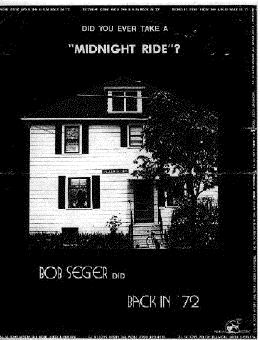
"Did You Ever Take A Midnight Ride?" the poster asks. "Bob Seger Did Back In '72." Hey, it's no more provocative than "Are You Experienced?"
The house itself, if memory serves, is the actual house where Punch and Palladium had their offices. The bicycle by the steps in front symbolizes...uh, nothing. And the people in the window are, I don't know, doing something. Remember, this is the John and Yoko Two Virgins Kick Out The Jams era, and given the times, the poster is actually pretty tame. The small type around the side says "Midnight Rider from the Album Back in '72. The Palladium Records/Reprise logo is down in the corner.
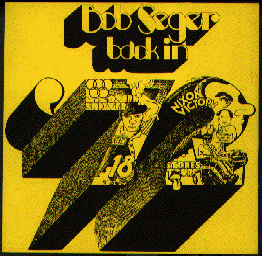
As if that piece of art isn't enough to stun you silly, we also later acquired Back in '72 stickers. (Actually Punch sent them to me. I sent him a dollar, and he sent me a couple of stickers and my dollar back. By Punch, I mean Punch, not some Punch-assistant. In my limited experience, Punch is nothing if not hands on.)
Basically the sticker was a type treatment of the album name, incorporating a lot of news headlines from the times. There was a more complex poster version which I took from a bar once, but did I have the sense to save it?
Anyway, here's the sticker:
Working with Muscle Shoals
The album was recorded partly at Muscle Shoals, partly with his own band, because Seger couldn't afford to record it all at Muscle Shoals.
"Warners...sent me down to record in Muscle Shoals with producers Brad Shapiro and Dave Crawford. They told Punch, 'We'll cut him for $1,500 a side.' We cut Van Morrison's 'I've Been Working' and two others the first day and I was sky-high, working with Roger Hawkins, Barry Becket and all these guys who cut with Aretha and everything. That night, though, Punch came into my hotel room and said, 'They want $1,500 a tune, not per album side,' and he had to tell 'em to forget it. I ended up doing the rest of the album pretty much alone with the Muscle Shoals guys, and I thought again, 'file these guys names away for future reference because they're something else.'" Chris Cioe, Musician. "Bob Seger: Hymns from the heartland."
Packaging
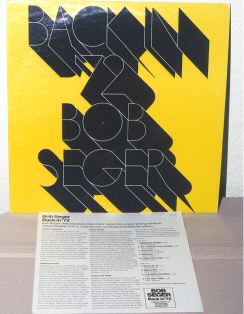
The Reprise release shipped with a promotional flyer tucked around the album, reading as follows:
"Bob Seger, who blended other folks' tunes into a best selling mixture called Smokin' O.P.'s, rolls his own on his second Reprise album. ['Best selling' in this context meaning nothing in particular: Smoki Nopes didn't chart. This is what you call hype.]"Back in '72 takes its title from a Van Morrison song which is of course included in the album." [The only sense I can make of this is that the album was originally to be titled I've Been Working. Maybe the new name was inserted in the flyer without anyone taking the time to notice that the sentence was no longer true.]
"Another standout musician heard on the album is Bill Mueller, leader of a Michigan group called Julia with which Bob toured extensively in early 1972. More recently Bob has been touring and recording with a quintet of musicians he picked up in Tulsa in the fall of 1972." I.e., the Bornea Band, or "My Band."
Bill Mueller -- now known as Blue Miller -- has a fine web site of his own. He contacted me a while back and was nice enough to fill in some details. You can read his full letter on the email page by clicking here...but to summarize, Julia was managed by a woman named Ann Marston who introduced the band to Punch. When she passed away, Punch became Julia's manager.
Shortly thereafter, Seger asked Mueller to sing background vocals on "Lookin' Back." For the tour supporting "Brand New Morning," Punch sent out Julia as an opening act. Seger then performed solo, and then Julia backed him for the final act. Later, Julia backed Bob on part of the "Smokin' O.P.'s" album tour.
When Bob took Bill down to Muscle Shoals without the rest of Julia, there was some resentment, and Julia broke up. Before "Back In 72" came out, Seger formed a band with Mueller on guitar, Marci Levy on background vocals, Jamie Oldaker on drums, Dick Sims on keyboards, Alto Reed on sax, (who at the time was still known as Tommy Cartmell), and Sergio Pastora as percussionist. By the time the LP came out, Mueller had moved on.
 O.P.'sMain
MenuSeven
O.P.'sMain
MenuSeven
- Do ya do ya wanna rock? Send your fond dreams, lost hopes, bittersweet regrets, half-remembered stories, rejoinders, rebuttals, questions, comments, corrections and contributions to:
 sparling@spiritone.com