|
|
|
|
The 2002
Updates
World
Series of Advertising They're the
longest-running, most dependable ads on the air,
er, trucks on the road. Okay, I admit it. I'm
proud of the Like A Rock ads. It simply wouldn't
be the World Series without Seger doing his five
seconds of perfection every other commercial
break. There's no chance in a million that I'll
ever buy a Chevy truck, so I'm free to ignore
the context and just enjoy hearing Seger's
singing, brief as it is. I hope the campaign
continues for another ten World Series.
Seriously -- I really do. But Old Navy
-- good lord, will someone please sell them a
treasured rock classic quick. I Want to Hold
Your Hand, Hotel California, Born to Run, Ode to
Billy Joe -- anything to replace their hoe-down
Green Acres send-up. The Old Navy music makes
you wish the baseball strike had really
happened. And finally,
in the Mommy, What's A Sex Machine? Category --
Why the #!?%# is Pontiac running its "Sex
Machine" commercial in movie theaters preceding
Spy Kids 2 and Tuck Everlasting? Are they
selling a lot of trucks to grade school kids, or
what? October 21,
2002
Borders. Best
Buy. Circuit City. Target. Go into the CD
section of any of these stores and what you'll
get is standardization. From Chattanooga to,
well, anywhere in the country, the selection is
about the same. Once in a while, though, you
find an independent store with the grit and
character to stand out from the corporate crowd.
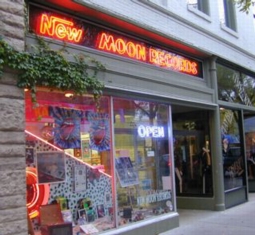
In Traverse City, Michigan, that store is New
Moon Records. Full of posters, new CDs and
rarities, old eight-tracks and a dog or two, New
Moon is a standard stop whenever the Seger File
visits Northern Michigan. Owner Mike
Parshall was Seger's road manager until 1969.
(In 1969, Richard "Kinkle" Kruetzkamp took over
as road manager for a couple of months; then
from spring '69 to summer of '74, Thomas
Weschler served as road manager. For a 1996
interview with Parshall, see the
Concerts
section of the Seger File.) This time
around, I found a copy of "Lookin' Back" in good
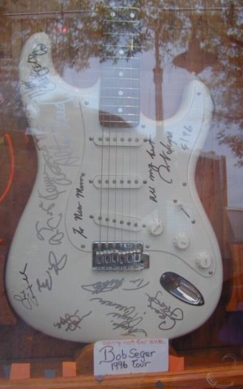
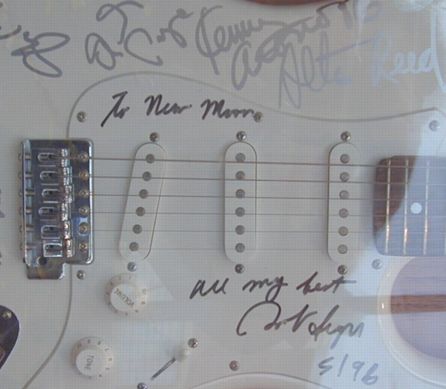
condition. On display was a guitar signed by Bob
and the band at the end of the 1996 tour and
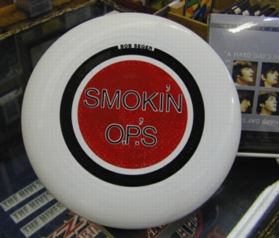
something I'd never seen before -- a Smokin'
O.P.'s Frisbee. Have a look: So if you're
in Northern Michigan, like me, looking for some
fall colors, you're out of luck: An unseasonably
warm fall means the trees are still green. But
if you're lucking for some Seger sights, pay a
visit to New Moon. You can visit New Moon on the
web here. October 12,
2002
Sometimes,
with Dylan, you don't know what he's playing
until you hear a line or two. It was that way
last night, four songs into his set in Eugene,
Oregon. Dylan was playing McArthur Court, where
the U of O plays basketball. The crowd was
packed in shoulder to shoulder, marijuana
mingled with incense in the air, and the band
started a ballad that I recognized but didn't
recognize. Until that
song, Dylan had been touching the lyrics
lightly, like a person sampling the emotions
involved. Now his demeanor changed, as he seemed
to pour the full force of his heart into the
song. Realization dawned on me with the line
"Never thought I'd have to pay so dearly / for
what was already mine / for such a long time."
It is part of the genius of Bob Dylan that he
continues to find new ways to amaze us. Last
night, the person who could easily be called the
greatest songwriter of our generation sent
chills down my spine by playing someone else's
song: Warren Zevon's "Accidentally Like A
Martyr." He didn't say
it was Zevon's song, and he didn't say that
Zevon is dying of lung cancer. He simply played
the song with passion. Later in the set, Dylan
and the band covered two more Zevon songs,
"Lawyers, Guns and Money," and "Mutineer."
Another performer might have made a big deal of
dedicating the songs to Zevon. But Dylan didn't
try to take credit for caring. No doubt he
played the three Zevon songs because he wanted
to, as a tribute from one musician to another.
Some of us in the audience knew the story behind
the songs and some didn't. And that was
fine. Dylan last
played Oregon almost a year ago, on October 7,
2001, the day we started bombing Afghanistan.
The show closer, "Blowin' In the Wind," struck a
particularly powerful note last year. Yesterday,
the song that seemed to vibrate with currency
was "Senor (Tales of Yankee Power)." The opening
line -- "Can you tell me where we're headin' /
Lincoln County Road or Armageddon?" -- seemed to
have been written for the warlike and uncertain
times we inhabit. Tales of Yankee Power
indeed. Since last
year's show in Oregon, Dylan has played 104
concerts across America and Europe. Thirty
more shows are scheduled between now and
Thanksgiving. I said it last year, and I'll
repeat it now: Dylan is at the height of his
powers. See this tour if you possibly
can. October 6,
2002 Summer Days
and Summer Nights Are Gone …Which
means it's time for the Seger File to move to
its Northern Michigan headquarters for a little
time in the woods. I have promised myself to
spend any rainy days reading the last two months
worth of unanswered e-mail. So if I owe you an
answer, there's still hope. If it
rains.
Once, when I
was walking along a beach in my Like A Rock
t-shirt, a super-thin woman in high-fashion
beachwear looked at me sassily and said, "Hi,
Rock." As a master of witty and seductive
repartee, I suavely replied, well…something
with edge and flair, I'm sure. Okay, actually I
just kept walking. This was fifteen years ago.
In the intervening years I still haven't thought
of a snappy comeback. I mention this
now not to highlight my lame conversational
skills, but as a prelude to my latest insight on
the Like A Rock campaign for Chevy.
Surprisingly, I want to say something very good
about the campaign -- something that has been
overlooked and uncommented-on, at least by me.
Until now, that is. Here it is: The most
successful automotive ad campaign of modern
times is built around a classic rock song that
has nothing to do with sex. Amazing, isn't
it? Think about the stunning implications of
this. More to the point, consider the
implications of every other rock campaign. In a
single night of moderate tube-watching, cars and
trucks have invited me to "Come and Get Your
Love," or to "Come On and Take A Free Ride"
(wink, wink). Pontiac, shamelessly selling cars
to the tune of James Brown's "Sex Machine,"
doesn't even bother with innuendo. Of course, the
vast majority of rock songs are about sex
anyway, on some level. And that's just fine with
me. Sex and music go together. But what happens
to the national psyche when you combine sex and
music and selling cars on the world's most
powerful media and repeat constantly from now
until, well, the end of time? The answer --
my answer, anyway -- comes from Philip Slater's
1970 classic, The Pursuit of Loneliness:
"Through the mass media, everything sexless has
been sexualized: automobiles, cigarettes,
detergents, clothing." We are "daily bombarded
with bizarre sexual stimuli and deranged and
erotic associations." The psychic result,
ultimately, is disconnection with a capitol D.
Slater's book begins with a quote from Paul
Simon -- "I'm empty and aching and I don't know
why." So, here's to
Seger for writing a classic song that's not
about sex. The skinny beach-woman was wrong.
Like A Rock is about commitment, not about
erections. And here, grudgingly, is to Chevy,
for not using sex as a sales weapon. Sell me
gas-guzzling, environment-wrecking SUVs and
trucks if you must, but don't mess with my
libido. It's messed up enough as it
is. October 6,
2002
By the time
"Face the Promise" came on, I'd been listening
to track after track of unreleased Seger:
Rarities spanning three decades, including the
full version of "Corners," a long version of
"Like A Rock" with an extra verse and many other
gems and near-misses. To be honest, after four
hours with the headphones on, my energy was
spent. There is such a thing, after all, as too
much Seger. "Face the
Promise" changed all that in under five seconds.
The energy, the confidence, the unmistakable
power and authority of the track -- and, my god,
the commanding vocals -- had me on my feet
instantly. This
was it -- the real thing. For the next
three and half minutes I simply stopped
thinking, the way you stop thinking
during great drama or great sex, and
just stood there soaking it all in.
Now, four days later, I can still hear
it playing in my head. Today,
the Seger File begins a multipart
series called Inside the Vault
-- the most detailed account of Seger's
unreleased music ever published
anywhere, on the Web or on paper.
Included is a close look at five new
tracks recorded for the upcoming album.
So say good-bye to the waiting. It's
time to face the promise of the
promised CD. Click
here to read the Inside
the
Vault. Timothy White,
music journalist and Billboard editor often
quoted on this site, passed away at age 50 last
June. White was one of the most intelligent and
skillful music writers I ever read. A site
commemorating his career -- and his commitment
to artists and their music -- can be found
here. September 3,
2002
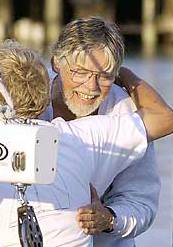
Bob Seger and
his crew of 11 once again took first place in
the annual Port Huron to Mackinac sailboat race.
It's the third time Seger has competed in the
race and his second victory --both in Lightning,
his 53-foot sailboat. Seger's corrected time was
39 hours, 44 minutes and 27 seconds. According
to Seger fan Bill Cook, who has inside sources,
the crew of Lightning was playing "Like A Rock"
at the dock when they knew they'd won. Seger is
quoted about "the light air, the close power
reaching, the hard tacking" in a Free Press
article here. For sailing
fans, the excitement may be over, but Seger fans
now await the Aftermath -- the post-race
interview in the Detroit News, wherein we get a
little morsel of news and potentially false hope
about the upcoming CD. (The fact that this
morsel may turn out to be untrue makes it no
less delicious, however.) Note to Susan Whitall:
Ask Bob how 9/11 affected his songwriting and
any of the other questions listed
here.
If and when an article appears, I'll post a
link. July 16,
2002
In July, the
Seger news comes not from the studio, but from
Lake Huron. This year, once again, Seger is
sailing in the Port Huron to Mackinac race;
Seger's boat, Lightning, came in first last
year. This year's race is expected to end early
Monday. To keep you
up-to-date, I'm in close contact with sources on
the lake. Indeed, just after noon eastern time,
the Coast Guard radioed the Seger File with this
report. (I could tell it was the Coast Guard
because of the way my table lamp blinked in
prearranged sequence -- the signal for me to
retreat to my underground communications HQ for
a top-level Seger transmission.) Here's what the
captain, or skipper, or whatever those Coast
Guard types are called, had to say: Coast Guard
report at 12:02pm - Near the front of the
fleet are Pied Piper (GL 70, 41104), Bob Seger's
Lightning (51152), Victrix (47001) and
Insatiable (GL 50, 42616). The rest of the fleet
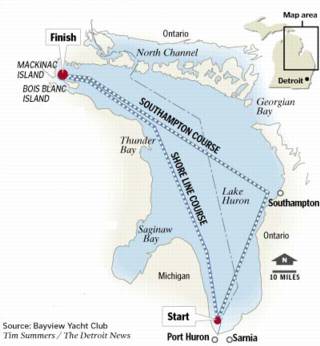
is to the SE, spread widely. In case you're
curious as to what this race is all about, check
out the neato map stolen from the Detroit News,
below. Roughly 250 sailboats race roughly 250
nautical miles. Seger races the Southampton
Course. And, as an
extra-special feature, this year the Seger File
includes the live, as-it-happens, Finish Line
Cam so you can see Seger's boat actually
cross the finish line. Or to be slightly more
precise, the Seger File includes the "Broken
Graphic" icon you'd get if you went to the
official race site and tried to view the
Finish Line Cam yourself. In the interest
of saving you time, we proudly present the
Broken Graphic icon right here. Stare at it
closely for several hours without blinking or
moving and you'll have a sense of what it's like
to wait for Seger's next CD. Whatever
the Fair Use statute says about stolen graphics,
I hereby invoke
it.
July 14,
2002
Maybe you
heard him at Cobo, or the Rock and Roll Farm, or
in some mega-arena. Maybe The Distance or
Against the Wind got you through some terrible
time in your life. Maybe Night Moves changed
something in your heart. Or maybe, thanks to
Bob, there's been a time in your life when you
couldn't believe what the band was putting
down. And now it's
time to give something back. That's right.
Seger's birthday is coming up, and those of us
who love his music are getting together to give
him a little present: A place in the Rock and
Roll Hall of Fame. Or at least a
nomination. Here's how you
do it. Go to Rock
the Hall
and sign the electronic petition to get Bob in
the Hall. Seger fan Eric Verona has put this
excellent site together to help rectify the
Hall's blind spot where Seger is
concerned. Think about
it: Seger -- with ten straight multi-platinum
albums, 19 Top-40 singles, a thirty-year career,
and nearly a million ticket sales the last time
he toured -- wasn't even nominated for the Hall
of Fame this year. Not even nominated. The
respected rock critic Stephen Holden of the New
York Times has described Seger as having "all
the requisites of greatness: the voice, the
songwriting, the performance onstage, the vision
and the ambition." And yet the Hall doesn't seem
to get the message. It's time to change
that. Seger's
birthday is May 6. We've gotten so much from
him. We should take a moment to give him
something in return. So, from now
on, the Seger File is no longer free. As the
price of admission, I'm asking you to go to
Rock
the Hall
and sign the petition. And then, of course, come
back. Updated April
28, 2002
I've always
felt that if you have to add more than 2 dB of
EQ to anything, you're in a salvage situation.
If you agree with that statement -- or if,
unlike me, you actually understand that
statement -- then you might also enjoy reading a
behind-the-scenes account on the recording of
"Night Moves." The session is recounted from the
point of view of producer Jack Richardson, who
says he "pushed Bob up a very little around the
1.6 to 1.8kHz range to accentuate the harmonics
in his voice." (Side note:
Richardson is the immensely successful producer
of the Guess Who and Alice Cooper who once said:
"The music business is a cruel and shallow
money-trench, a long plastic hallway where
thieves and pimps run free and good men die like
dogs. There's also a negative side.")
James
Reaney, London Free Press, October 3, 2001.
"Jack Richardson nursed the Guess Who to stardom
and began a legend." At any rate,
Richardson's version of how "Night Moves" came
together is a little different from Seger's; the
story can be found here.
Thanks to Seger fan Michael Funk for the Night
Moves article and to Seger Dew Liner Randy
Cepuch for the London Free Press
piece. Speaking of
things worth reading, the latest edition of the
All Music Guide to Rock from the
AllMusic.com people is now in bookstores. The
book rates over 12,000 albums by more than 2,000
artists and groups -- including a very good
Seger section written by Stephen Thomas
Erlewine. The Guide profiles every Seger album,
even the out-of-print ones. Two
coincidental facts: Erlewine's uncle played the
harmonica on "Down Home" in the late sixties.
And it was a Seger File reader / contributor
(who shall remain nameless) that helped Erlewine
score those out-of-print Seger albums so the
reviews could be written. And speaking
of music that is out-of-print, several months
ago Seger File upstart Sean P. was kicking
around the Web and found RealPlayer samples of
five cuts off Mongrel, including gems like
"Highway Child" and "Song to Rufus." You could
snoop around and find them yourself, or just
click here. Finally, here
and there I've managed to do a little mini-Seger
File update, thanks to info sent in by readers
about Seger soundtracks, Julia, the Detroit All
Stars, Seger songs covered by others, and of
course, the Oakland Mall concert. May 12,
2002
Actually, not
that long at all. Face it: You can hardly watch
an hour of TV anymore -- let alone a major
broadcast such as the Academy Awards -- without
feeling like you're at a rock concert during
every commercial break. The Beatle's "Taxman"
for H&R block. Stevie Wonder's
"Superstitious" for the latest high-emission,
low-mileage SUV. Led Zeppelin for
Cadillac. In other
words: All of "Truck's" children are on-air,
making their pitch*. Sure, it's not
entirely "Like A Truck's" fault. But when the
most successful automotive ad campaign in modern
times is built around a rock song, it just
naturally spawns a lot of imitators. In the ad
business, imitation isn't the sincerest form of
flattery. It's the sincerest form of greed.
Which leads me to the following
question. Who is the
rock band that sells out the most? Correct. Asked
and answered. The Who. Advertisers seem to own
their entire catalogue. Nissan is no doubt
paying Pete Townshend big bucks and calling it a
bargain, the best they've ever had. Not content
to bastardize one song, Clarinex packs a whole
medley of Tommy tunes into its latest spot.
Remember when the rock opera claimed "We're not
gonna take it?" It turns out they are gonna take
it...all the way to the bank. This is the
band, of course, that titled one of their
biggest albums "The Who Sell Out." What a hip,
with-it joke that was: As if one of the world's
most rebellious bands would ever stoop to
selling deodorant. Now the joke has lost its
humor. The album title is no longer sarcastic:
it's real. As it happens,
The Who were the makers of the first piece of
recorded music I ever purchased with my own
money: I Can't Explain. A three-minute slice of
musical perfection at 45 rpm. I've lugged it
around with me for more than three decades,
through nine states, a zillion apartments, two
houses, three major girlfriends and a wife. I
don't ever play it, because I can hear it note
for note in my head anytime I want. I'll
probably keep it 'til I die. Still, I'm
waiting for the day I turn on the TV and hear it
being used to pitch a cell phone, a sports car
or a diet pill. I'm pretty convinced it'll
happen, sooner or later. And for Pete's sake,
why? Aren't these guys already bazillionaires?
Maybe it's Michael Jackson's fault; maybe The
Who don't own their own catalogue, in which case
I take back all my nasty comments. Maybe that's
it. Otherwise, I can't explain. _______________ *("Making
somebody rich. It's a come-down, baby, cause
rock and roll was never for this." ) March 29,
2002
Outsider
music, that is -- music with a raw unpolished
charm, made outside the mainstream. Last week's
NYT mag says outsider music is a "reaction to
the kind of ultrapasteurized pop music we've had
to live with for the past few years....Music
fans have been waiting -- and waiting -- for the
next real thing, for a rough original band to
sweep in (the way Nirvana did in the early
'90s)." We're thirsting for a raw, direct kind
of music, rough-hewn and real, says the article
by Dwight Garner. Garner, who's
a big-time editor at the NYT Book Review, has
probably been reading this web site. I'm sure he
got his ideas from my little screed on this very
page, where I yearn for a new Seger CD: "One
with less production -- something closer to demo
tapes than finished recordings....Give me take
one with Seger and keyboards, any time. The
rawer, the better." You can scroll down forever
and read the Seger File piece for yourself under
Seger
In the Raw,
or just click. The same
magazine has a charming interview with Barry
Manilow, by the way. "I stand for emotional,
truthful pop music," says Manilow, who then
adds, "I don't listen to pop music....I've never
really been a pop music fan." His early songs
demonstrate "how out of touch with pop music I
was. I still am." Yeah, right. Personally, I
stand for emotional and truthful social
discourse with Uma Thurman, except that I'm not
an Uma Thurman fan. In fact, I've always been
out of touch with her and still am. Sure. Time
for your medication, Mr. Manilow. March 22, 2002
with apologies to Sean.
Actually, I've
never been to Nashville. But Laura Creamer has
-- you recognize her name from the last seven
Seger albums, right? -- and she brings a little
Seger news with her. For the tidbit behind this
teaser, click
here. February 15,
2002 Nashville
Update from the Seger DEW Line An April
release? Seger DEW Liner Jesse B. dishes out
more Nashville info and serves up a prediction.
Click
here
for the update. February 21,
2002
I've always
loved the back of 'Back.' In fact, I'd say the
'Back' back is one of the finest in the
rack.* Lest you think
you've stumbled into the Tom Leykis site by
mistake, let me hasten to add that the rack in
question is the Seger rack, and the back is the
back cover of "Back in '72." I've admired it
(not everyday, you understand, but off and on)
for thirty years. But it took an e-mail from an
upstart Seger fan named Sean to get me to look
at it really closely. Which led to an
interesting discovery. Before we go
any further, let me say that those of you who
believe Seger's first album was Live Bullet are
now excused. The rest of you might want to put
on your white linen gloves, open your
humidity-controlled, airtight, double-locked
album vaults and come back with
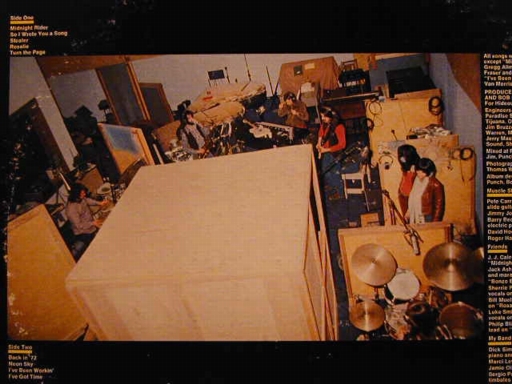
"Back." Got it? Okay,
take a look at the photo on the back. I think
it's extremely cool, mainly because of its
complete lack of pretense. There's a big honkin'
sound booth or something in the center of the
photo. Everybody's looking away from the lens,
as if they have no idea the photographer is
there. There's no rock 'n' roll posturing --
instead, the photo has a real you-are-there
sense of what a Seger recording session looked
like in those days. Enter Sean,
the upstart fan who was born the month "Back in
'72" was released. After a landing a copy of
this rare Seger album, he e-mailed me with a
rave review and a question: "Is that a can of
Coors Alto Reed is drinking on the
back?" Hmm. Maybe.
Indeed, using advanced photo-analysis techniques
(a bright light and a magnifying glass) I'd have
to say...yes, I think that is definitely a can
of Coors. But wait -- how could it be?? This
photo was taken in 1972, and Coors wasn't
distributed nationally until years later. Did
Bob and the boys bring back a trunkfull of Coors
while they were getting out of Denver, perhaps?
Or -- bingo -- is the presence of Coors a
tip-off that the Borneo Band was recording west
of the Mississippi? Only one man
would know for sure. Well, actually many men
would know for sure, but only one man with an
e-mail address available to me: the photographer
himself, occasional Seger File contributor
Thomas L. Weschler. I dispatched a query and
hence came the reply: "You are
right! We were at Leon Russell's home in Tulsa,
OK. Thanks for the compliment, I always liked
that shot too. As for the cover...Punch did not
like any of the photos we had available and the
deadline was looming...so Carol got the
call!" Aha. Just as I
thought! Not that I know who Carol is, exactly.
Someone who got the call, obviously and good for
her. No problem -- I like having a little
mystery left. Anyway, I passed this amazing
tidbit on to Sean and got the following message
back. "Funny how a
guy can own an album as long as someone else has
been alive, and then the young upstart notices
something he never did. I think the photo is
interesting because it's so "regular," i.e.
unposed and unplanned; probably Seger and Reed
and the others didn't even know it was being
taken, so it's more like a shot from some
not-quite-forgotten party, and that sort of
thing always fascinates me." There you have
it. That would be the end of the story except
for the e-mail that came in from Scotland
today. "If there is
one thing in my life that is missing, then that
would be to have "Back in '72" on CD. I remember
the day I bought the album. I went into an
import shop in Glasgow (Scotland) and this album
was playing. It was the title track. It was the
rawness and the energy that drew me to it. I
bought it without hearing any other track. I
didn't normally do that. It's one of the few
albums I can honestly say I love every track.
But constant playing has left its mark. I know
of many of Bob's fans who would love to own this
gem just the way it was made...no remastering or
tinkering with it, just as it first appeared all
those years ago. Let's start a petition and see
if we can change the great man's mind. Please
issue "Back In '72" on CD. Regards, Mike Dillon,
Paisley, Scotland." In other
words, bring back "Back." -- (Thanks to
Sean and to Mike Dillon for their e-mails and to
Thomas Weschler for the info above and the photo
below.) The back of
"Back in '72." Photo by Thomas
Weschler. *It's
right up there with, say, the back of
Seven. February 18,
2002 Update:
Carol, says photographer Weschler in today's
e-mail, "is Ms. Bokonowicz (sp?) a young (17 at
the time) art student whose artistic input we
sought on a regular basis. She was called upon
to do the front cover of Back In '72." The same
batch of e-mail brought more information about
the musicians on Back in '72, and how they
transitioned from Seger to Leon Russell to Eric
Clapton. Check it out, here. Buy the Seger
File a cup of coffee. Here's
how.
Do ya do ya do ya wanna rock? Send your fond dreams, lost hopes, bittersweet regrets, half-remembered stories, rejoinders, rebuttals, questions, comments, corrections and contributions to: |
|---|


 2003
Updates
2003
Updates