An unofficial web site about the music of Bob Seger
Archived Updates -  Jan - June 2003
      For the latest updates, see News & Updates page.
            Written and edited by Scott Sparling
sparling@segerfile.com
Capitol
Reaches "Dee-Pah" Into Vaults for Ancient Live
CD
For a while
now, industry outsiders such as myself have
wondered how long Capitol Records would wait for
a new CD from Bob Seger. Apparently, the new
faces in Capitol's hip boardrooms have decided
eight years is enough, as they announced the
release next month of "DEE-PAH" -- a live album
of vintage Seger that Capitol originally
rejected in the early 1970s. The CD, which
includes a commemorative booklet and poster, can
now be reserved at Amazon.com.
The good news
is that the wait is finally over. DEE-PAH will
be a treat for fans who hunger for Seger's
rougher, rawer earlier days (myself included).
The DEE-PAH concerts were recorded in 1971 and
feature the last live performance of the Bob
Seger System, as well as tracks by Seger with
Teegarden and Vanwinkle.
The bad news,
I suppose, is that the CD may signal a rift with
Capitol, since Seger has long opposed releasing
the material.
Some quick
background for those who came in late: Seger
signed onto Capitol in 1968 and issued four
albums. But the Capitol crowd in the late 1960s
consisted of old guys more interested in The
Lettermen than rock and roll. The label's lack
of interest turned Seger's early albums into
instant cut-out bin fodder. After Mongrel died,
Seger was ready to bolt, but he owed them one
more album, so Bob and Punch conceived the idea
of DEE-PAH -- a live album recorded at Hill
Auditorium in Ann Arbor and at the Chillicothe
Rock Festival in Ohio.
The music was
never recorded with the intent of being
released. The Hill Auditorium show was actually
taped at the request of System drummer Pep
Perrine, who wanted a personal souvenir of the
last System show. The promoter of the
Chillicothe festival -- mindful of the highly
successful Woodstock album -- decided to record
the Ohio festival (without the band's
permission, it turned out) hoping to cash in
with a soundtrack of his own.
Rejected, then
resurrected: Seger's live album from the 1970s.
To reserve a copy at Amazon.com, click the
cover.
Punch had to
sue to get the tapes, but eventually DEE-PAH was
put together and delivered as Seger's fourth
album, fulfilling his contract. Capitol took one
listen and said "No way." Ultimately, Brand New
Morning was issued instead.
Soon
afterward, Seger left Capitol and recorded three
albums on his own label, which was picked up by
Warners. By then, a group of young turks had
taken control at Capitol and they quickly
invited Seger back. Then we all lived happily
ever after, until recently, when a new group of
young turks began pawing through the
vaults.
The irony is
delicious. Thirty years ago, Seger wanted to
release DEE-PAH and Capitol didn't. Late last
year, the players reversed themselves. With the
wait for Seger's upcoming CD stretching into its
eighth year, it was Capitol arguing to release
the material, and Seger who was
balking.
The tapes,
however, legally belong to Capitol. Clearly,
someone at the label has decided that it's
better to make a few bucks and risk Seger's
wrath, than to keep waiting for new
material.
(This isn't
the first time Capitol has rejected and then
released a Seger album -- see the item below on
how the label originally rejected both Live
Bullet and Night Moves.)
All of
that, of course, is insider baseball. The real
question for fans is, Does DEE-PAH deliver?
To which I emphatically respond: Indeed it
do.
It's a short
CD at just 33 minutes -- but every one of them
is springloaded with vintage Seger. The title,
as you've certainly guessed, comes from the
stellar howl at the end of "Heavy Music" -- the
final track from the Hill Auditorium concert.
The Ann Arbor crowd goes wild and Seger prods
them on with the famous refrain: "Deeper! Going
dee-pah! Faster, look around." This is the
"Heavy Music" of the System, not the retooled
"Heavy Music" that the Silver Bullet Band later
played at Cobo. Both are classics, but the
original retains the raw, erotic, garage-rock
sound of the single.
The CD is
worth it for that track alone. But the rest of
the set (or what we hear of it) also delivers.
Knowing it's their final show, the System plays
a high-gear, no-holds-barred set that includes
"Song to Rufus," "Ivory," "Innervenus Eyes" and
"2+2=?" This last song rings out with urgent
authority, given that this was the height of the
Vietnam antiwar movement.Who would have thought,
back then, that the same song would be just as
urgent and meaningful today?
The Hill
Auditorium cuts were probably meant to be Side
One of the orginal LP. The tracks are tight,
fast, hard-hitting and sonically very clear. All
in all, some great cuts from a great
show.
Of course, I'm
biased. I was there -- June 10, 1971, getting
high on Seger and holding hands with my high
school girlfriend. Can life get any
better?
The Ann Arbor
show ended one chapter for Seger. By the time of
the Chillicothe Festival, three months later, he
was already touring with Teegarden and
Vanwinkle. That show was equally amazing. The
one-day outdoor festival was essentially a hot
August Saturday of scorching sun, beer, grass
and midwest rock and roll. Seger came on early
in the evening and played his solo Brand New
Morning set -- just him, a stool and a
guitar.
Onstage in Ann Arbor and
Ohio: The CD comes with a commemorative poster.
(Click to enlarge.)
The great
Michigan band, SRC -- soon to become Blue
Sceptor -- came on last and played a dynamite
set climaxing with "Gypsy Eyes." By now it was
fully dark and the Quackenbush twins had the
crowd on its feet. That seemed to be the end,
until suddenly Seger was back. I don't know if
it was planned, but the festival became a Battle
of the Bands at that point. SRC had the crowd on
the ropes and then Seger came back and delivered
the knockout punch. I know, because I was there,
too. (Don't hate me because I'm lucky. Hate me
because I was young and had nothing better to do
than hitchhike around the midwest and go to rock
concerts.)
Sadly, the
Chillicothe half of DEE-PAH is a bit truncated.
"River Deep, Mountain High," which drove the
crowd nuts, is not included -- probably because
a similar version was already on Mongrel. On the
other hand, a ragged version of "Lookin' Back"
was included and probably should have been
skipped.
Hot night in Chillicothe:
Seger rocks the crowd.
But there are
a couple of gems. One is "Driving Wheel" the Tom
Rush ballad that Seger frequently covered. The
second is "Leaning On My Dream" -- another
antiwar song from the System, adapted here with
an organ solo by Skip Knape and a beautifully
crisp vocal by Seger.
Unfortunately,
the night's highlight -- a ten-minute version of
"Lucifer" that closed the festival -- was
omitted in favor of "God Love & Rock 'n'
Roll." That track, a Skip Knape song, is
essentially the same version most collectors
have heard from "Ten for Two," the John Sinclair
concert. Given the limits of LPs, it probably
wasn't feasible to include the extra-long
"Lucifer." But what a bonus track that would
make for a future CD.
The other cool
thing about DEE-PAH is the booklet. This is the
first time Capitol has taken a stab at anything
like a boxed-set booklet, and the results are
outstanding. I won't give away all of the
surprises, but two of the most interesting
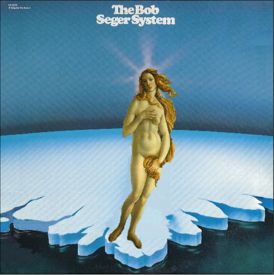
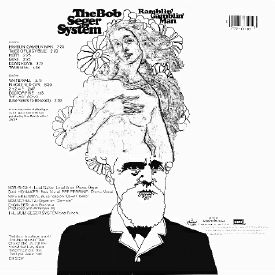
images are the orginal front and back of
Ramblin' Gamblin' Man, before the conservative
folks at Capitol decided Botticelli's Venus was
too racy for America's youth and changed the
naked lady into a blue-robed ice queen. No
wonder Seger left the label!
The original artwork for
Ramblin' Gamblin' Man. Preview copies of the
"Venus" cover sell for over $100 on
eBay.
For Seger
collectors who have hoarded bootleg copies of
DEE-PAH (although rare, it's been in circulation
off and on over the years), the booklet provides
a reason to plunk down your $17.95 for an
official copy.
I particularly
love the background stories. According to the
booklet, the unofficial censor at Capitol at the
time was a man named Richard Fineman. He was
notorious for screwing up album art and was
known by the derogatory nickname "Dr. Fine." The
little note from Seger on the back of RGM
("Thank you, Dr. Fine") is meant to be sarcastic
-- as in, Thank you for screwing up the cover of
my album. One can only guess how many tens of
thousands of sales were lost thanks to Capitol's
squeamish art department.
One can also
only guess what the release of DEE-PAH means for
Seger and Capitol. Have they given up waiting
for a new CD? Does DEE-PAH fulfill its destiny
by fulfilling Seger's Capitol contract? Does it
herald a label switch, a rift, another two or
three years of waiting, or nothing at
all?
As in all
things Seger, the zen wisdom applies. Those who
say don't know. And those who know don't
say.
In the
meantime, we can all enjoy going
dee-pah.
This
is the April 1 post for 2003.
For
more falsehoods, see the Seger File's April 1
post for 2010,
2009,
2008,
2007,
and 2005.
Capitol Punishment: Early Platinum
Albums Nearly Nixed by Label
Think Capitol would
never reject a live album, and then change their minds?
Think again. Turning thumbs down on potential platinum
was practically a trend in the early days. Seger's
manager Punch Andrews describes the situation in this
1986 interview with Timothy White.
Andrews: "We love
Capitol, they're like family now, but at the time they
were quite conservative. In fact, every time I asked
for anything they would tell me, 'The Lettermen don't
get that, and so you're not going to get it.'
"The period around
1972 when [Bob] left Capitol for Reprise and
then got dropped was the hardest time. Nobody knows
this, but Warner Bros. rejected Beautiful Loser
outright and Bob and I were dead broke. I had to find
a way to borrow $1000 to remix the tape to play it for
Capitol at a time when I had $4000 worth of $3
bounced-check charges against me."
"Nobody also knows
this, but after Capitol welcomed us back for Loser,
they turned around and rejected Live Bullet, thinking
it was a cheap excuse for Frampton Comes Alive. It was
a long, long argument.
"After Live Bullet
hit, Capitol rejected Night Moves...They thought it
wasn't as exciting as Live Bullet had been! No wonder
Seger has so much heartache these days deciding
whether he's got a finished record or not."
Timothy White,
1986 interview, "Bob Seger Forgives But He Doesn't
Forget."
March 31, 2003. True.
A Personal
Note
Last April --
after five years writing and editing the Seger
File -- I took a short break from the site...as
you no doubt noticed if you e-mailed me during
that time and got no response. Now I'm back, and
I'll try to do better.
Of course, the
nice thing about running a Seger site is that
you can fall asleep for months at a time and not
miss anything. While I was gone, an inmate
somewhere had "You'll Accomp'ny Me" played
during his execution. A remastered Against the
Wind was released. (Question to audiophiles out
there: How's it sound? Should I buy it?) Seger
decided not to enter the Port Huron / Mackinac
yacht race this year, due to a family reunion.
He's still finishing his next CD. Dee-Pah isn't
real. Never was.
There. Now
you're up to date.
July 19,
2003
Bob Seger, Public Menace
Some of us
just want Seger to finish the new tracks he's
working on. Others hope he gets off track -- off
the railroad tracks, that is.
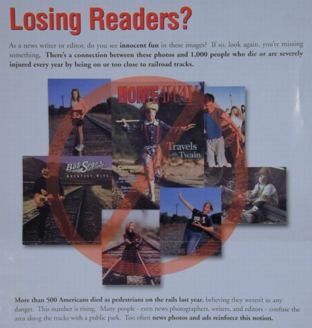
A railroad
industry group called Operation Lifesaver has
contacted newspaper editors across the nation,
warning them against glamorizing dangerous and
illegal acts of trespass along our nation's rail
lines. The group is distributing a poster that
features the cover of Seger's greatest hits CD,
showing the Train Man astride the tracks with
his ax.
"Do you see
innocent fun in these images?" the copy asks.
The inconsistently punctuated message advises us
not to confuse the tracks with a public park.
Click on the image for a larger
version.
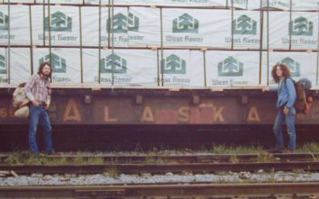
I got my copy
of the poster from my lifelong friend, Seger DEW
liner and respectable newspaper editor Jesse B.
-- pictured below in Prince Rupert, Canada,
violating the property rights of the Canadian
National Railroad with the future editor of the
Seger File, a scant 24 years ago. Jesse's the
one with the long hair and backpack. And that
leads me to my rebuttal.
Yes, standing
on the tracks is dangerous. It's no place for
kids or fashion models. The danger shouldn't be
trivialized. At the same time, America's romance
with the rails has been on the rocks for four
decades or more. We need more trains, more
tracks and more people who think railroads are
cool.
When Seger
stands by the tracks -- or when Warren Zevon
sings "Nighttime in the Switching Yards" -- it
stokes a fire that needs stoking. Let's not get
so cautious that we lose the allure of the rails
entirely.
In short,
Operation LifeSaver is a good thing. Maybe we
need an Operation RailSaver too.
February 17,
2003
Seger Ribbed on
Simpsons
In episode 301 of The
Simpsons, which aired last night, Homer watches a
commercial for the latest sandwich at Krustyburger. Over
plenty of slide guitar, a smokey-voiced singer tells us
the new mystery meat sandwich is "Like A Rib."
February 17,
2003
Stoned...
The Ann Arbor music
scene gets a rave review in the current issue of Rolling
Stone. To give readers a sense of history, the geniuses
at RS list three important bands/performers from Ann
Arbor: The Stooges, Brownsville Station and
Taproot.
Yep, that about covers
it.
Cloned...
It's time to get
down...down on the farm, that is. Tim McGraw's 1994
record, "Down On the Farm" -- which continues to get
airplay as part of his greatest hits album -- is an
undisguised knock-off of "Horizontal Bop." Same song,
different lyrics. Amazon calls McGraw "dumb, derivative
and fun." I'll buy that, except for the fun
part.
And Disowned.
In this post-9/11
world, no advertiser wants to appear unpatriotic. So at
GM -- where stock prices have lost 40 percent of their
value over an arbitrarly selected timeframe -- even the
successful "Like A Rock" campaign has been the subject of
concern, according to rumors made up by me. Now comes
word from GM Chairman Rick Wagoner, appearing as a watery
image on my bedroom ceiling during a particularly
feverish point of my recent bronchitis bout, that the
truck division will no longer use Seger's song as its
anthem. "We don't want anyone to think we 'Like Iraq,'"
Wagoner did not say. (The company hopes to license
Springsteen's "Born In The USA" as a replacement, in the
same sense that they hope gold pellets will fall from the
sky.)
February 8,
2003
Cars and
Stars
The man who's
sold thousands of trucks was buying cars last
week -- or at least looking at them. Seger
joined 150,000 other auto aficionados at the
prestigious Barrett-Jackson Collector Car
auction in Scottsdale, Arizona. Other
celebrities included Don Johnson, Tim Allen,
Cheech Marin, Reggie Jackson, Alice Cooper, and
Mark Anthony of Van Halen.
More than 800
cars were on the auction block, most of which
were snapped up. Last year's top sale was a
sweet little '66 Ford Coupe, which went for a
cool $405,000.
My '91 Mazda
needs a new muffler, by the way, but I'm going
to keep driving it anyway until the neighbors
file an injunction. Times are tough.
January 24,
2003
Seger,
shown here 33 years before attending the auto
auction.
Searching for Seger on CKLW
Recently I read about a
documentary being filmed called "Radio Revolution: The
Rise and Fall of the Big 8." The film focuses on CKLW
radio in Windsor -- one of the stations that helped make
Seger a regional rock star years before the rest of the
world knew his name. During the late '60s, a promo piece
says, "CKLW dominated the airwaves and turned on the
world to Motown, soul and rock and roll."
The filmmakers are
looking for any audio (or video) of Bob being interviewed
on CK:
"As you know,"
the producer writes, "the music director of the
station, Rosalie Trombley, was a huge Bob Seger
fan, and of course his song Rosalie, is about her.
The "tower and the power" he sings about is CKLW
and its huge antenna that perched on the Detroit
River in those days.
At some point
after Live Bullet was recorded, Bob came to Windsor
to tape an interview with then Program Director Les
Garland (who went on to be the first PD of
MTV)."
"When the interview
began, Bob clammed up," his email continues, so
ultimately Rosalie conducted the interview herself. "I
have this story from both Garland and from Rosalie," the
producer writes. "What I don't have is any audio of that
interview, which presumably made it to air at some point.
Any idea where I might find it? Or any other audio (or
video) of Bob talking about Rosalie, CKLW and Detroit
radio in general?"
If you've got any
clues, drop me an email here,
and I'll forward it on to the filmmakers.
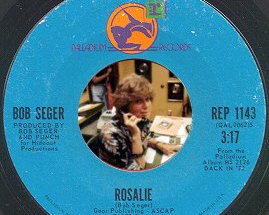
Rosalie:
She had the power.
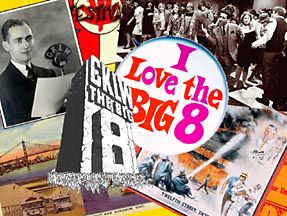
CKLW:
They had the tower.
January 22,
2003
Sail On
Someone in the Navy
must like Bob Seger. As part of the pre-war deployment,
the Navy is sending sailors to sea to the tune of "Roll
Me Away." Here's how USA Today described it.
"To the wail of Bob
Seger's 'Roll Me Away,' the Tarawa Amphibious Ready
Group set sail Monday toward the gulf from San Diego
on a long-planned, six-month deployment. Once in the
gulf, the ships will meet up with the USS
Constellation aircraft carrier battle group."
Cesar G.
Soriano, January 16, 2003, USA Today. "Modern Marines
have better ways to get ashore."
The fact that several
news organizations carried this same tidbit makes you
wonder if the song was played for the sailors' enjoyment
or for the benefit of reporters. And it's anybody's guess
as to whether the enlisted men felt lost, double-crossed
and sick of what's wrong and what's right. Or whether two
plus two was on their minds.
The same week saw
another, admittedly subtle, national media reference to
the same song. It was on Letterman, during a bit about
driving across Montana. "You get to the border and just
roll that power on," Dave said. I don't know if he knew
he was quoting Seger. But that's the power of a great
lyricist -- his words sneak into our conversations almost
without our knowledge.
Do ya do ya
do ya wanna rock? Send your fond dreams, lost
hopes, bittersweet regrets, half-remembered stories,
rejoinders, rebuttals, questions, comments,
corrections and contributions to:
 Photos
2
Photos
2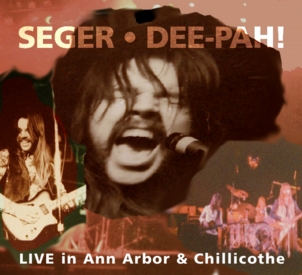
 Latest
Updates
Latest
Updates
 sparling@segerfile.com